Most moving companies work with a patchwork of systems. Not because they want to, but because it grew that way. And honestly: it works. Until it doesn't.
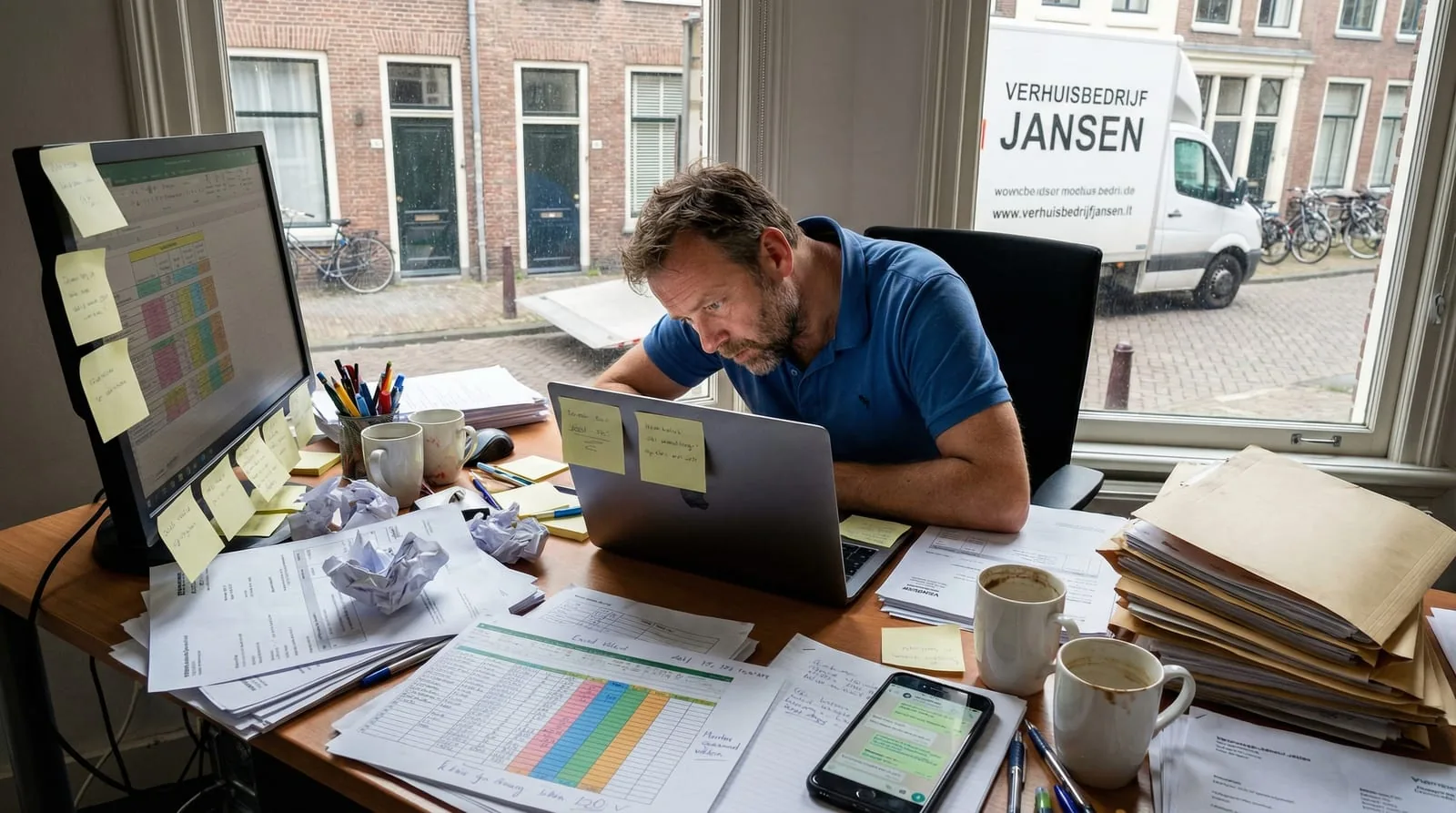
It often starts small. An Excel file for quotes. A Google Calendar for planning. WhatsApp for communicating with your drivers. Paper job sheets that get handed in at the office after the move. And accounting software where everything eventually has to be entered by hand.
Sound familiar? Then you also know how it feels when a customer calls about a quote your colleague sent last week - and nobody knows where it is. Or when you discover after the fact that a move took three hours longer than planned, but the job sheet only arrives days later.
Why is the problem not that your tools are bad?
Excel is fine for a spreadsheet. Google Calendar works for appointments. WhatsApp is handy for quick questions. The problem is that all those separate tools do not talk to each other. Every time you transfer information from one system to another, it costs time. And with every manual step, errors creep in.
Think about everything that happens manually in an average move. The request comes in through your website or phone. Someone creates a quote in Excel. Customer agrees? Then the move needs to go into the schedule. The crew gets instructions via WhatsApp. Afterwards, someone fills in a job sheet. That sheet gets retyped at the office. And then an invoice still needs to be created.
That is at least six moments where the same information is entered again. Six chances for errors. And six moments where someone's time is spent on administration instead of work that actually matters.
What does that chaos actually cost you?
Most moving companies have no idea how much time goes into this kind of double work. That makes sense - it is so intertwined with daily operations that it becomes invisible. But add it up.
Suppose you spend 30 minutes per move on duplicate entry, searching for information, and coordinating via WhatsApp. With 10 moves per week, that is 5 hours. Per month, 20 hours. Per year, almost 250 hours. That is more than six full working weeks spent on things that did not need to happen.
"It is not about the big mistakes. It is the hundred small moments per week where you think: there must be a smarter way."
And we have not even mentioned the errors yet. A wrong address on the job sheet. A quote that gets followed up too late because it sat in someone's inbox. A customer who calls twice because nobody can find the previous note. Those things cost not just time, but also customers.
Why "just a better Excel" is not the solution
The first instinct is often: let's improve the Excel file. More columns, more tabs, maybe some color coding. Or you switch to Google Sheets so everyone can access it. But the problem is not your spreadsheet. The problem is that your information is scattered across ten different places.
What you actually want is that when a customer agrees to a quote, that move automatically appears in the schedule. That your driver sees the details on their phone without someone having to message them. That hours and materials are recorded digitally and flow directly into the invoice. That at any moment you can see how your business is doing - without having to open three systems first.
Why does a platform work better than ten tabs?
That is exactly why more and more moving companies are switching to a platform that combines everything. From quote to invoice, from planning to job sheet, from customer contact to reporting - everything in one place. Not because it is trendy to digitize, but because it simply works better.
At Bas, we built that platform specifically for moving companies. Not as generic business software that you have to set up yourself, but as a solution that fits how moving companies actually work. With a quoting module that is faster than Excel. With a planning overview that updates your team in real time. With digital job sheets that your drivers fill in on their phone. And with reports that show you what is really going on in your business.
The best part: you do not have to change everything at once. Most companies start with the area where the biggest pain is - often quotes or planning - and expand from there step by step.
How quickly do you notice the difference?
What we often hear from moving companies that make the switch: it is not about that one big improvement. It is the dozens of small things that together make the difference. No more searching for quotes. No more misunderstandings about the schedule. No more paper job sheets getting lost. No more endless retyping at the end of the day.
And perhaps most importantly: clarity. Knowing how many quotes are outstanding. Seeing which moves are scheduled for next week. Checking at a glance whether revenue is on track. Those kinds of insights you previously only had after the fact - when it was already too late to adjust course.
"We used to spend an hour a day on things that now happen automatically. We now spend that time on our customers."
The question is not whether digitization is right for your moving company. The question is how long you want to keep waiting. Every week you continue with the patchwork of systems is a week where you are leaving time and money on the table. Maybe not a lot per day. But it adds up.
Shall we grab a coffee?
Let's chat about how things can work smarter in your business.
Online or on-site - you choose.