Contact
EN - English
NL - Nederlands
EN - English
FR - Français
DE - Deutsch
Solution

Sales
Sales
Efficient from lead to booking

Invoicing
Invoicing
Never miss an invoice again

Planning
Planning
Always the optimal schedule

Insights
Insights
Datadashboard with all your KPIs

Exeution
Execution
All employees fully informed

Integrations
Integrations
Connect to your ICT environment

Storage
Storage
Make storage work for you
For whom

Startups
Startups
Save time to grow your business

SME
SME
Work smarter with Bas

Enterprise
Enterprise
Collaborate optimally
References
Pricing
Switch
Blog
Request demo
Text Link
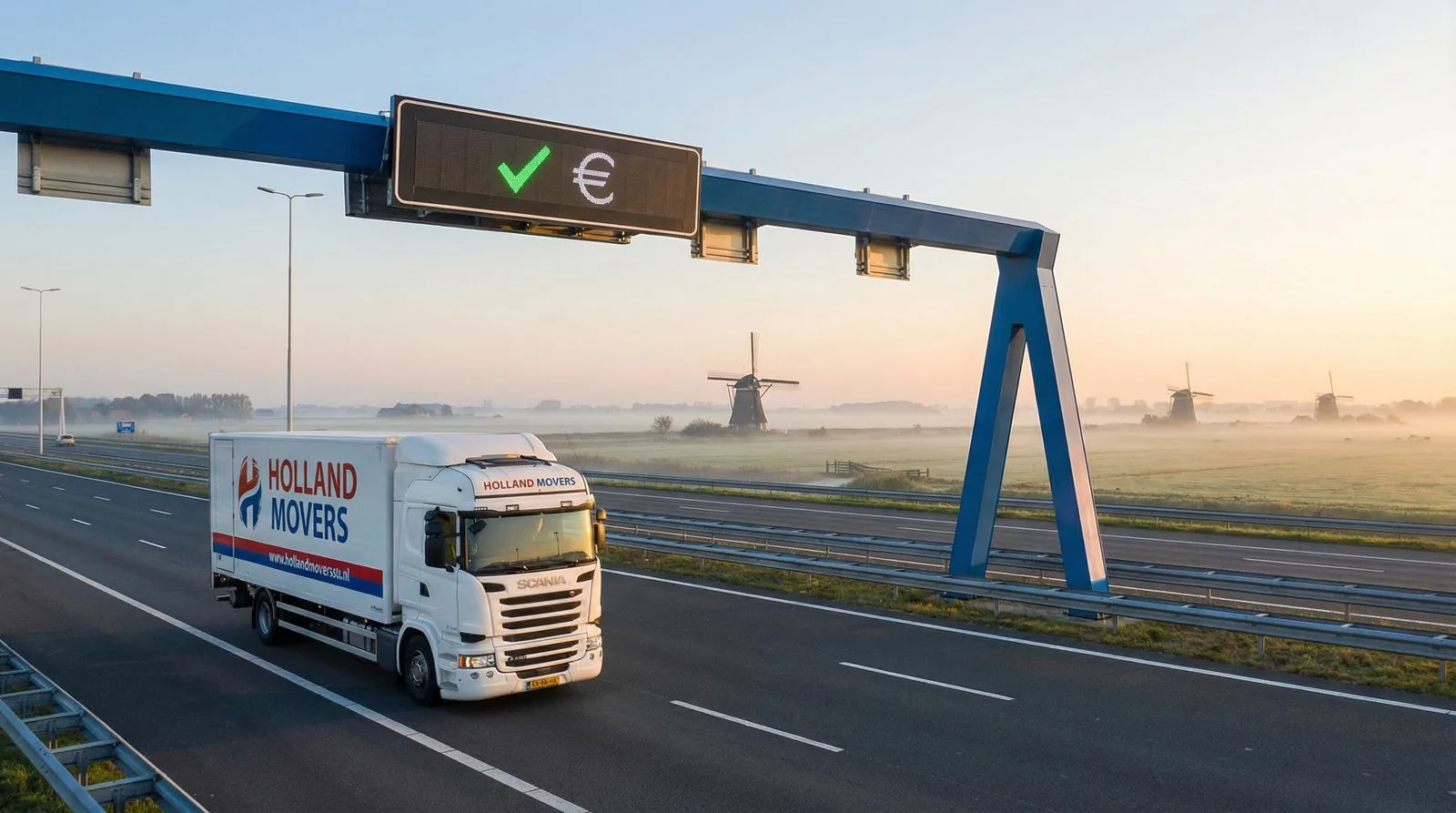
<article class="article"> <!-- Header --> <header class="article-header"> <div class="article-meta"> <span class="article-category">Legislation</span> <span class="article-meta-dot">&bull;</span> <span class="article-read-time">8 min</span> </div> <h1 class="article-title">Truck toll 2026: what it means for movers</h1> <p class="article-intro">Starting July 1, 2026, you will pay an average of 19 cents per kilometer with your moving truck. The new truck toll affects every moving company in the Netherlands. What does this mean for your rates?</p> </header> <!-- Hero Image --> <img src="https://cdn.prod.website-files.com/671a8a32ce21bb65df4b3506/697a975639eafb39ca83bd70_697a97523df856c1fd70fa03_blog-vrachtwagenheffing-header-v2.jpeg" alt="Moving truck on the highway with a toll gate in the background - illustration about truck toll for moving companies" class="article-hero"> <!-- Content --> <div class="article-content"> <p class="lead-text">The moment the moving industry has been anticipating for years is coming. On July 1, 2026, the truck toll will take effect. Every moving company with vehicles over 3,500 kilograms will be affected. And it will cost you more than you think.</p> <p>Does this sound familiar? You have just set your rates for the new year. Collective labor agreement wages have risen, fuel prices fluctuate, and you are trying to stay competitive. And then another cost is added that you have little control over.</p> <p><strong>The truck toll will cost an average of thousands of euros per truck per year.</strong></p> <h2>What is the truck toll?</h2> <p>The truck toll is a new per-kilometer charging system that will be introduced in the Netherlands on July 1, 2026. The system is simple: you pay per kilometer driven on the designated road network.</p> <p>These are the key features:</p> <ul> <li><strong>Vehicles from 3,500 kg</strong> - All trucks in category N2 and N3 are included</li> <li><strong>Highways and provincial roads</strong> - Approximately 3,900 kilometers of roads where the toll applies</li> <li><strong>Rate per kilometer</strong> - Depending on the emission class of your vehicle</li> <li><strong>Cleaner = cheaper</strong> - Electric and zero-emission vehicles pay the lowest rate</li> </ul> <p>For moving companies, this means that virtually all moving trucks fall under the toll. The average moving truck weighs well over 3,500 kilograms. There is no avoiding it.</p> <h2>What does the truck toll cost per kilometer?</h2> <p>The rate depends on the emission class of your vehicle. The dirtier the engine, the higher the rate. These are the rates as of July 1, 2026:</p> <div class="tariff-cards"> <div class="tariff-card"> <div class="tariff-card-type">Diesel Euro 5</div> <div class="tariff-card-value">&euro;0.185</div> <div class="tariff-card-label">per kilometer</div> </div> <div class="tariff-card highlight"> <div class="tariff-card-type">Electric</div> <div class="tariff-card-value">&euro;0.032</div> <div class="tariff-card-label">per kilometer</div> </div> </div> <h3 class="table-title">All rates by emission class</h3> <div class="table-container"> <table> <thead> <tr> <th>Emission class</th> <th>Rate per km</th> </tr> </thead> <tbody> <tr> <td>Euro 0 to III</td> <td><strong>&euro;0.218</strong></td> </tr> <tr> <td>Euro IV</td> <td><strong>&euro;0.200</strong></td> </tr> <tr> <td>Euro V / EEV</td> <td><strong>&euro;0.185</strong></td> </tr> <tr> <td>Euro VI (a to c)</td> <td><strong>&euro;0.157</strong></td> </tr> <tr> <td>Euro VI (d and e)</td> <td><strong>&euro;0.152</strong></td> </tr> <tr> <td>Zero-emission (electric)</td> <td class="positive"><strong>&euro;0.032</strong></td> </tr> </tbody> </table> </div> <p>Most moving companies drive Euro V or Euro VI trucks. So expect a rate between 15 and 19 cents per kilometer.</p> <h2>What does the end of the Eurovignette mean?</h2> <p>There is also good news. The Eurovignette you currently pay will be discontinued on July 1, 2026. No more annual costs of over a thousand euros per truck. The motor vehicle tax (MRB) for trucks will also be abolished or significantly reduced.</p> <p><strong>But note:</strong> the savings do not offset the new costs.</p> <div class="callout warning"> <div class="callout-icon">&#9888;</div> <div class="callout-content"> <div class="callout-title">Note: new costs higher than savings</div> <div class="callout-text">The Eurovignette currently costs approximately EUR 1,250 per year. At 60,000 toll-liable kilometers, you will soon pay over EUR 11,100 per year. The difference is significant.</div> </div> </div> <h2>Example calculation: truck toll for moving companies</h2> <p>Let us calculate concretely. An average moving company drives about 60,000 kilometers per year per truck, most of which is on toll-liable roads.</p> <div class="calc-box"> <h3>What will the truck toll cost you?</h3> <div class="calc-comparison"> <div class="calc-item"> <div class="calc-item-label">Now (Eurovignette + MRB)</div> <div class="calc-item-value">&euro;4,204</div> </div> <div class="calc-arrow">&rarr;</div> <div class="calc-item"> <div class="calc-item-label">Soon (truck toll)</div> <div class="calc-item-value">&euro;11,100</div> </div> </div> <div class="calc-result"> <div class="calc-result-label">Extra costs per truck per year</div> <div class="calc-result-value">+&euro;6,896</div> </div> </div> <p>This example is based on a Euro V truck with 60,000 toll-liable kilometers per year. With multiple trucks, these costs double or triple.</p> <h2>How do you pass the truck toll on to customers?</h2> <p>You can pass on the truck toll in several ways. Most moving companies choose one of these three approaches:</p> <div class="steps"> <div class="step"> <div class="step-number">1</div> <div class="step-content"> <div class="step-title">Include it in your hourly rate</div> <div class="step-description">Increase your hourly rate by a fixed amount. At an average of 150 operating hours per month per truck, this amounts to approximately EUR 4 per hour extra.</div> </div> </div> <div class="step"> <div class="step-number">2</div> <div class="step-content"> <div class="step-title">Calculate a surcharge per kilometer</div> <div class="step-description">Add a transparent kilometer surcharge to your quote. With <a href="/oplossing/verkoop">quoting software</a> you can make this clear to the customer and cover your actual costs.</div> </div> </div> <div class="step"> <div class="step-number">3</div> <div class="step-content"> <div class="step-title">Increase your total price</div> <div class="step-description">Adjust your base rate with a percentage. An increase of 5-7% covers the extra costs for most moving companies.</div> </div> </div> </div> <div class="highlight-box"> <p>"Transparency works best. Explain to customers why your rates are increasing. The truck toll is national news - most people understand it."</p> </div> <h2>Which vehicles are covered?</h2> <p>The truck toll applies to all motor vehicles in category N2 and N3. These are vehicles designed for the transport of goods with a maximum mass exceeding 3,500 kg.</p> <p><strong>Note:</strong> it is about the permitted maximum weight, not the actual weight. An empty moving truck with a maximum weight of 7,500 kg is also covered.</p> <h3>Which vehicles are exempt?</h3> <ul> <li><strong>Vehicles under 3,500 kg</strong> - Vans and light commercial vehicles</li> <li><strong>Classic vehicles</strong> - Vehicles 40 years or older</li> <li><strong>Defense vehicles</strong></li> <li><strong>Emergency vehicles</strong> - Fire department, ambulance, police</li> <li><strong>Agricultural vehicles</strong> - Tractors and similar</li> </ul> <p>For most moving companies, this means the larger moving trucks do fall under the toll, but the smaller vans do not.</p> <h2>What subsidies are available for cleaner vehicles?</h2> <p>The government is making a total of EUR 253 million available to help transport companies become more sustainable. The largest portion goes to the AanZET subsidy.</p> <div class="info-cards"> <div class="info-card"> <div class="info-card-value">&euro;253M</div> <div class="info-card-label">Total subsidy budget</div> </div> <div class="info-card"> <div class="info-card-value">&euro;100K</div> <div class="info-card-label">Max. AanZET per vehicle</div> </div> <div class="info-card"> <div class="info-card-value">83%</div> <div class="info-card-label">Savings with electric</div> </div> </div> <p>The AanZET subsidy covers up to EUR 100,000 per zero-emission vehicle. This can make purchasing an electric moving truck significantly more attractive. Especially since electric driving also saves you 83% on the truck toll itself.</p> <div class="callout info"> <div class="callout-icon">&#9432;</div> <div class="callout-content"> <div class="callout-title">Tip: invest in electric now</div> <div class="callout-text">With current subsidies and lower toll rates for electric vehicles, the payback period for an electric moving truck may be much shorter than you think. Request a quote and calculate it.</div> </div> </div> <h2>How do you prepare?</h2> <p>The truck toll is coming. You cannot avoid it. But you can prepare. This is what you need to do now:</p> <h3>Short term (before July 1, 2026)</h3> <ul> <li><strong>Register your vehicles</strong> - Sign up with RDW and register all toll-liable vehicles</li> <li><strong>Choose a payment method</strong> - Via an On-Board Unit (OBU) or automatic license plate recognition</li> <li><strong>Adjust your rates</strong> - Calculate the impact and incorporate it into your new price list</li> <li><strong>Inform your customers</strong> - Communicate proactively about the rate change</li> </ul> <h3>Long term</h3> <ul> <li><strong>Analyze your fleet</strong> - Which vehicles do you replace and when?</li> <li><strong>Explore electric alternatives</strong> - With subsidies and lower tolls, this can be profitable</li> <li><strong>Optimize your routes</strong> - Fewer kilometers means less toll. With <a href="/oplossing/planning">planning software</a> you can combine trips more efficiently</li> <li><strong>Consider a mix</strong> - Vans under 3,500 kg for short trips, trucks for large jobs</li> </ul> <h2>Conclusion</h2> <p>The truck toll is a fact. Starting July 1, 2026, you will pay an average of 15 to 19 cents per kilometer with your moving truck. For an average moving company, this means thousands of euros in extra costs per year, per truck.</p> <p>You have two choices. You can wait and hope for the best. Or you prepare now, adjust your rates, and communicate clearly to your customers.</p> <p><strong>The companies that act now will not face any surprises later.</strong> Also read how <a href="/blog/digitalisering">digitalization makes your moving company future-proof</a>.</p> <!-- CTA --> <div class="cta-section"> <h2>Stay in control of your costs with the most complete software for movers</h2> <p>With Bas software you have insight into all your trips, kilometers, and costs.<br>In 30 minutes we will show you how it works.</p> <a href="https://bas.software/demo" class="cta-button">Book your demo now</a> </div> <!-- Summary --> <div class="summary-box"> <h3>Truck toll 2026 summarized</h3> <ul class="summary-list"> <li><span class="label">Effective date</span><span class="value">July 1, 2026</span></li> <li><span class="label">Vehicles</span><span class="value">From 3,500 kg (N2/N3)</span></li> <li><span class="label">Diesel rate (Euro V)</span><span class="value">&euro;0.185 per km</span></li> <li><span class="label">Electric rate</span><span class="value">&euro;0.032 per km</span></li> <li><span class="label">Eurovignette</span><span class="value">Discontinued</span></li> <li><span class="label">Subsidy (AanZET)</span><span class="value">Up to EUR 100,000</span></li> </ul> </div> <!-- Sources --> <div class="sources"> <strong>Sources:</strong> Dutch Government, RDW, Ministry of Infrastructure and Water Management, TLN, SRVN. </div> </div> </article>

Vind je dit artikel leuk? Deel nu

LinkedInFacebookWhatsAppDeel

Recente blogartikelen

News
•
5 minutes
From Excel and chaos to overview in 1 platform
Innovation
•
5 minutes
Electric moving: how far the industry has come in 2026
News
•
6 minutes
Finding staff: 5 tips to attract drivers

Werk ook efficiënter met de meest complete software voor de verhuizer

Neem contact met ons op voor meer informatie of boek direct een demo.
In 30 minuten weet jij hoe Bas jouw bedrijf kan helpen.
Boek nu je demo
Bas was developed by moving companies for moving companies.
The most comprehensive software for your moving company, enabling you to manage every move smoothly and clearly.
General terms and conditionsPrivacy policy
Solution
SalesPlanningExecutionStorageInvoicingInsightsIntegrations
For whom
StartupSMEEnterprise
More
ReferencesPricingSwitch
Bas.
ContactAbout usVacaturesRoadmapBlog
Contact
+31 (0) 85 30 33 415
KVK 80229646
info@bas.software