Saturday, seven in the morning. Your crew is standing by the box truck, the tail lift goes down and by five the job is done. A good day. But what does that day actually cost you in wages? How much break time comes off the hours? And is your crew entitled to an allowance because they were away from the yard all day?
The answer is in the CLA. It is just a booklet of more than a hundred pages, written for the entire transport sector. Below is what really matters for a Dutch moving company.
The CLA for movers in short
- Which CLA? Road Haulage CLA (TLN)
- Term 1 January 2026 to 1 January 2027
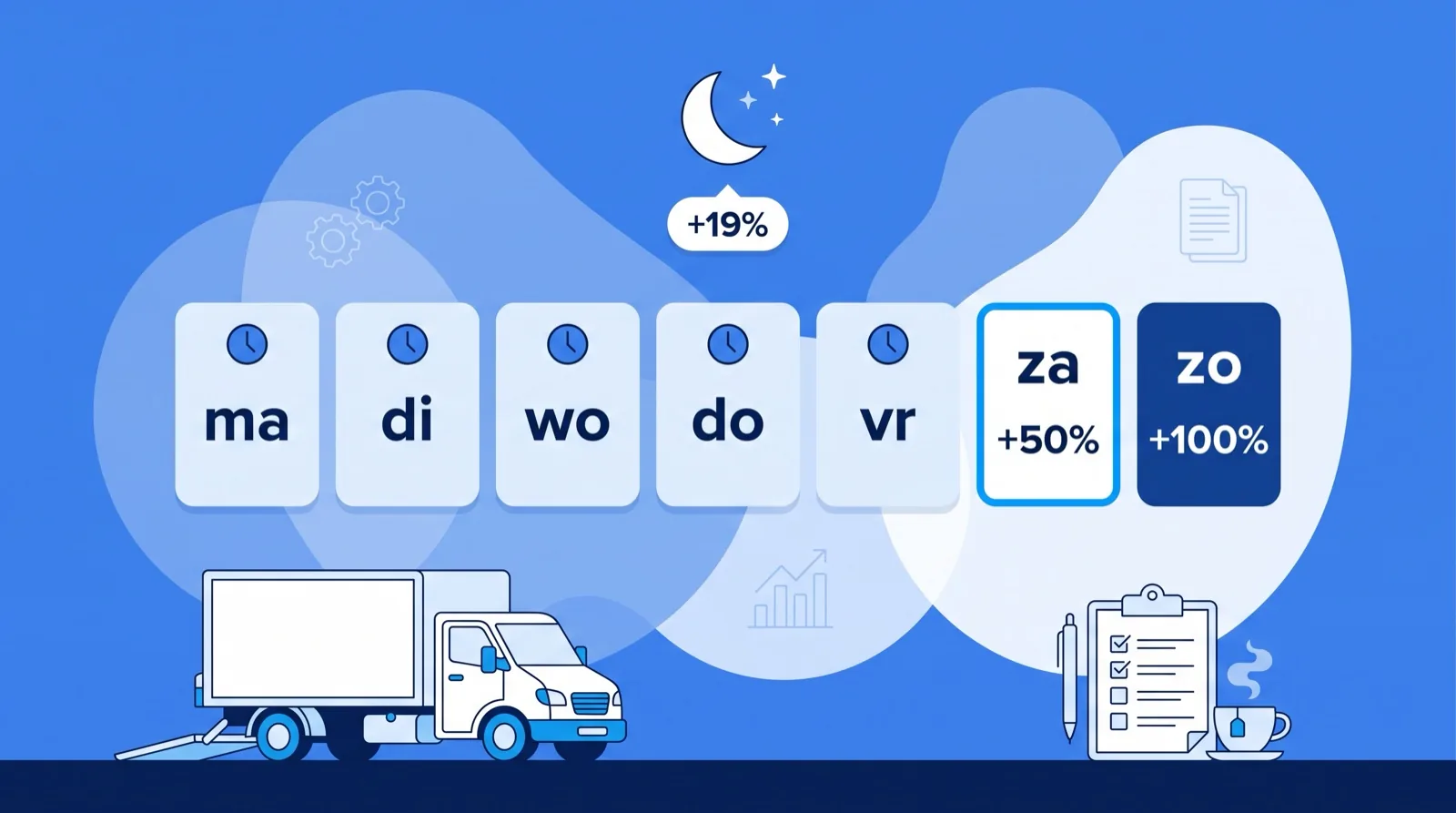
- Saturday 50% surcharge on all hours
- Sunday 100% surcharge on all hours
- Overtime 30% above 40 hours a week
- Night (21:00 to 5:00) 19% on single-day trips
Which collective agreement applies to movers?
Movers in the Netherlands fall under the CLA for Road Haulage and the Rental of Mobile Cranes (cao Beroepsgoederenvervoer). There is no separate CLA for removals. The agreement covers companies that transport goods by road for payment, and that is what you do on every move. The job classification handbook that belongs to the CLA therefore has its own chapter of removal jobs, from assistant mover to foreman.
Since 7 July 2026 the CLA has been declared generally binding. That means it applies to every company in the sector, even if you are not a member of the employers' association TLN. The current CLA runs until 1 January 2027.
Which surcharges apply to movers?
The CLA has five surcharges that come up often in removals. Each one is a percentage on top of the hourly wage.
| When | Surcharge | What counts |
|---|---|---|
| Overtime | 30% | Hours Monday to Friday above 40 hours a week |
| Saturday | 50% | All hours on Saturday |
| Sunday | 100% | All hours on Sunday |
| Public holiday (not a Sunday) | 100% | Or a day off within eight weeks, the employee chooses |
| Night, 21:00 to 5:00 | 19% | Only on single-day trips |
A few details make the difference in practice. Overtime is counted per week, not per day: a long Tuesday only becomes overtime when the week goes above 40 hours. The CLA rounds overtime to half hours, and less than fifteen minutes does not count. The night surcharge comes on top of an overtime surcharge. The public holidays in the CLA are New Year's Day, Easter Monday, Ascension Day, Whit Monday, both Christmas days and King's Day. Liberation Day only counts in a jubilee year, so not in 2026.
How much break time comes off the hours?
The CLA deducts breaks from the paid hours according to a fixed schedule. The longer the working day, the more break time.
| Length of the working day | Break deducted |
|---|---|
| 4.5 to 7.5 hours | 30 minutes |
| 7.5 to 10.5 hours | 60 minutes |
| 10.5 to 13.5 hours | 90 minutes |
| 13.5 to 16.5 hours | 120 minutes |
| 16.5 hours or more | 150 minutes |
Note the difference between the schedule and the law. The schedule decides how much break time you deduct from paid hours. The Dutch Working Hours Act and the transport working hours decree decide how much break time someone must take at a minimum. For drivers of trucks over 3.5 tonnes, the European driving time rules come on top: after 4.5 hours of driving, a 45-minute break is mandatory.
What is your crew entitled to on a long day?
On a single-day trip you pay subsistence allowances as soon as your crew is away from the yard for more than four hours. This is a net allowance on top of wages.
| Situation | Allowance (net) |
|---|---|
| More than 4 hours away from the yard | €0.83 per hour |
| Hours between 18:00 and 24:00, left before 14:00 | €3.77 per hour |
| Left after 14:00 and at least 12 hours away | €15.73 one-off extra |
For commuting, the CLA pays €0.23 per kilometre. The first 10 kilometres do not count and the allowance stops at 35 kilometres one way. If you arrange transport yourself, for example because the crew leaves from the yard, the allowance does not apply.
In Dutch transport this subsistence allowance is usually called coffee money (koffiegeld): a tax-free allowance for food and drink on the road. If you agree more with your people than the CLA requires, record it just as carefully as the CLA rules, or in two years nobody will remember who is entitled to what.
Worked example: what does a Saturday move cost extra?
Take a crew of three movers in job class D, step 3. Their hourly wage from 1 January 2026 is €17.99. They work from 7:00 to 17:00, so a ten-hour working day. Under the schedule one hour of break comes off, leaving nine paid hours.
On Saturday 50% is added, so the hourly wage becomes €26.99. For the same job, that adds up:
| Same job, 3 movers × 9 hours | Hourly wage | Gross wages |
|---|---|---|
| On a Tuesday | €17.99 | €485.73 |
| On a Saturday (+50%) | €26.99 | €728.73 |
| Extra for the Saturday | +€243.00 |
Then add the coffee money, because the crew is away from the yard for more than four hours. And you have not counted employer costs yet. They make an hour of wages considerably more expensive, as we worked out in the real cost of a mover per hour. If you charge the same rate for a Saturday as for a Tuesday, you give up margin on that day.
What does the CLA require you to record?
The CLA requires you to record each employee's hours on a timesheet. At a minimum it must show:
What the timesheet must show (article 26a)
- The date
- Start and end time of the working day, with the daily total
- Rest time
- Breaks
- Corrections to the hours
- The employee's name and signature
After checking, the employee gets a copy signed for approval. With loose paper timesheets in the cab that is a lot of work, and that is exactly where things go wrong. A forgotten break, a Saturday that ends up in the books as a normal working day, or an evening nobody recognised as a subsistence allowance. Every mistake costs you money, or your employee misses out.
The CLA is not complicated because the rules are hard. It is complicated because you have to apply the same rules again every week, for every employee and every job.
How do you get it right every week?
The easiest way is to set the rules up once and let them be applied automatically. In Bas your employees record their hours in the app, and after the job the foreman confirms the hours of the crew. Read more about the app and the foreman under execution. You approve the hours in the back office, with a warning when a break is missing.
Bas then calculates the CLA surcharges and allowances automatically: overtime, Saturday, Sunday, public holidays and night, plus fixed allowances per hour or per day, such as the coffee money. At the end of the pay period you export everything to Excel for your payroll. Bas does not calculate travel costs per kilometre, reduced working hours or shift allowances; you handle those the way you do now. How time tracking works step by step is explained in time tracking and CLA allowances in a few clicks. Leave, sickness and balances per employee are under HR.
A new CLA is coming. The amounts in this article come from the 2026 CLA, which runs until 1 January 2027. TLN and the unions start negotiating the 2027 CLA on 9 October 2026. As soon as it is agreed, we will update this article.
Shall we grab a coffee?
Let’s talk about how to get the CLA rules right in your company.
Online or on location, you choose.
Collective labour agreement for Road Haulage and the Rental of Mobile Cranes 2026 (TLN), articles 2, 25, 26a, 27, 29, 32, 33, 37, 39a, 40 and appendix III. Declaration of general applicability, Staatscourant 2026, 7211. TLN, job wage scales as of 1 January 2026. STL, job classification handbook for removal jobs. Dutch Working Hours Act article 5:4 and Working Hours Decree for Transport article 2.5:6. TLN, announcement of the start of the 2027 CLA negotiations (25 September 2026).