Moving on from MoveMan, Moveware or Supermove?
If you run a removal company on MoveMan, Moveware or Supermove, you already know what your system does well. These are established products that people rely on every day.
This page is for the moment you start wondering whether the daily grind around it could be simpler. Not because those are bad products, but because most of them were shaped in a different era, and it shows in how the day runs.
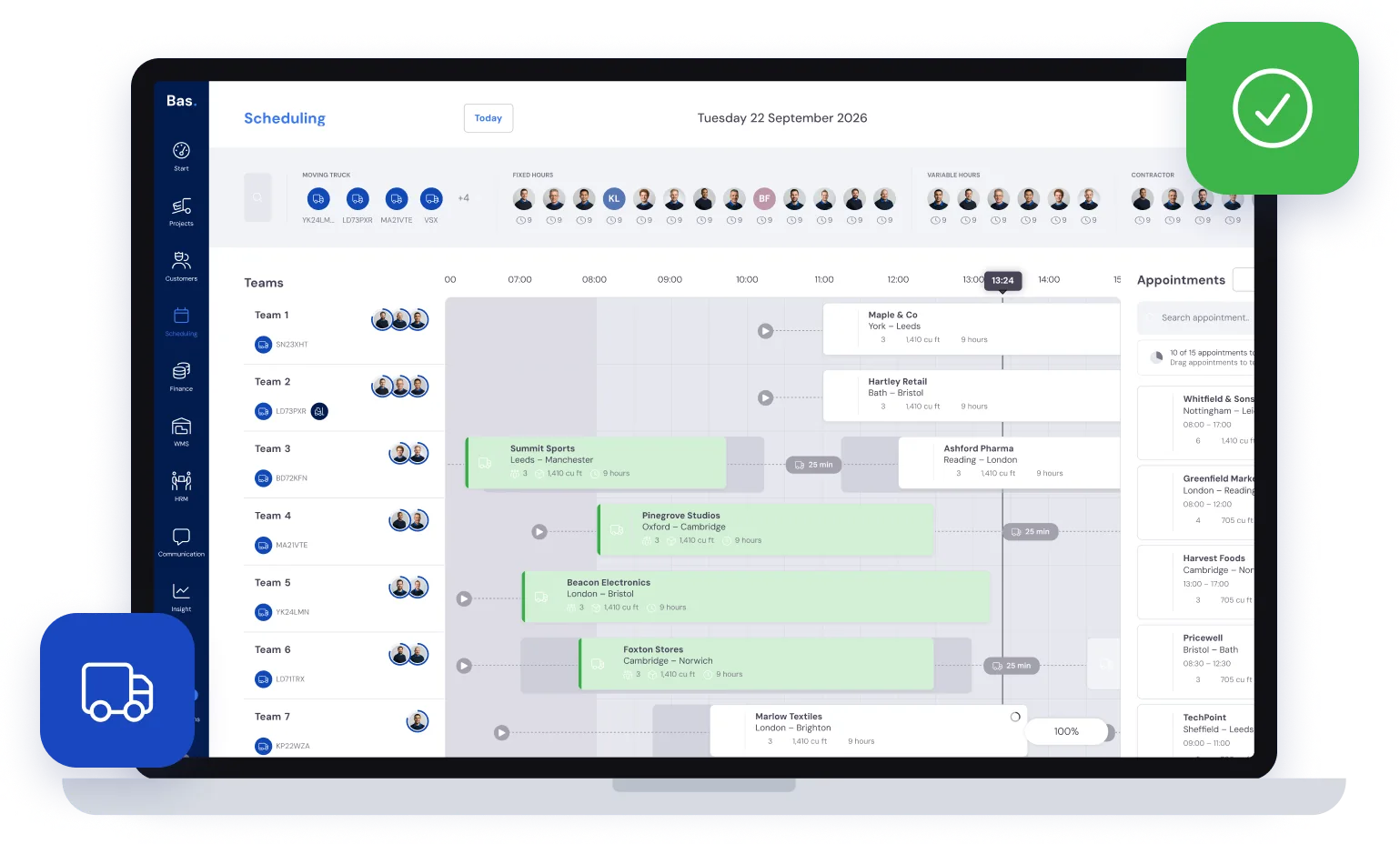
Most removals software is designed by developers who interviewed a few removal firms. We ran one.
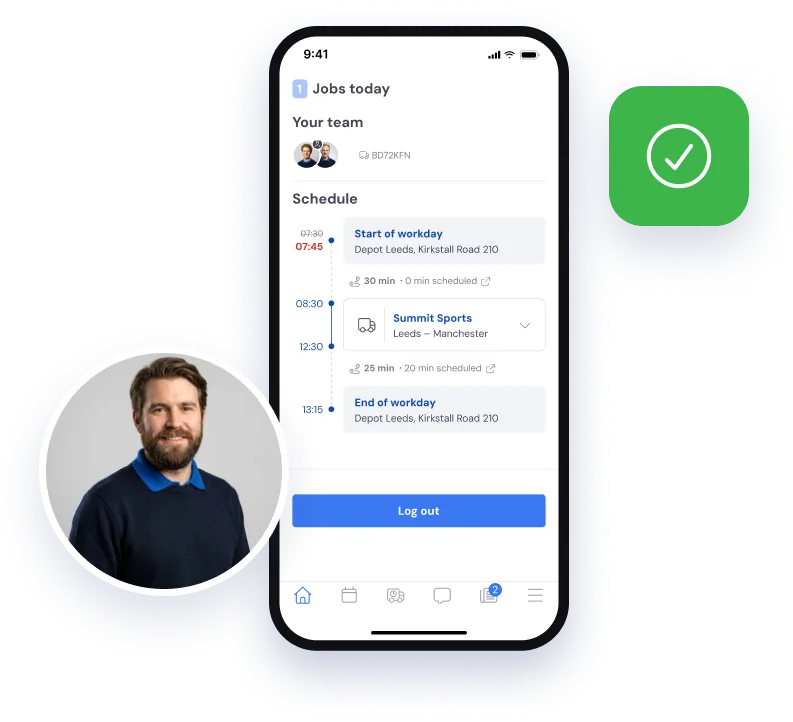
We didn’t come from software. We came from the vans.
Before Bas existed, we ran a removal company ourselves. Three things kept happening.
A customer would tell us, on the morning of the move, that they’d agreed something with our salesperson. An extra room. The shed. Two wardrobes that weren’t on the list. It wasn’t written down anywhere, so it came down to whose word you took, with a crew standing in the hallway waiting.
A quote would sit on somebody’s desk. Three days later the customer would ring to ask where it was. By then they’d already called someone else.
And the one nobody forgets: a booked job that never made it into the diary. The phone goes at half seven in the morning, the customer is standing between their boxes, and you’ve got no van and no crew. There’s no good answer to that call.
Every screen in Bas exists because of a morning like that.
Built in 2020, in a market of long-established suppliers
We started in 2020, in a market where everyone else had decades of history. Today, we’re the market leader in the Netherlands and Belgium, with 88 removal companies and more than 2,500 people using Bas every day.
The same system runs a two-person operation and a firm with over a hundred staff. There’s no cut-down edition for smaller companies: it’s the same removal company software whether you run two vans or thirty.
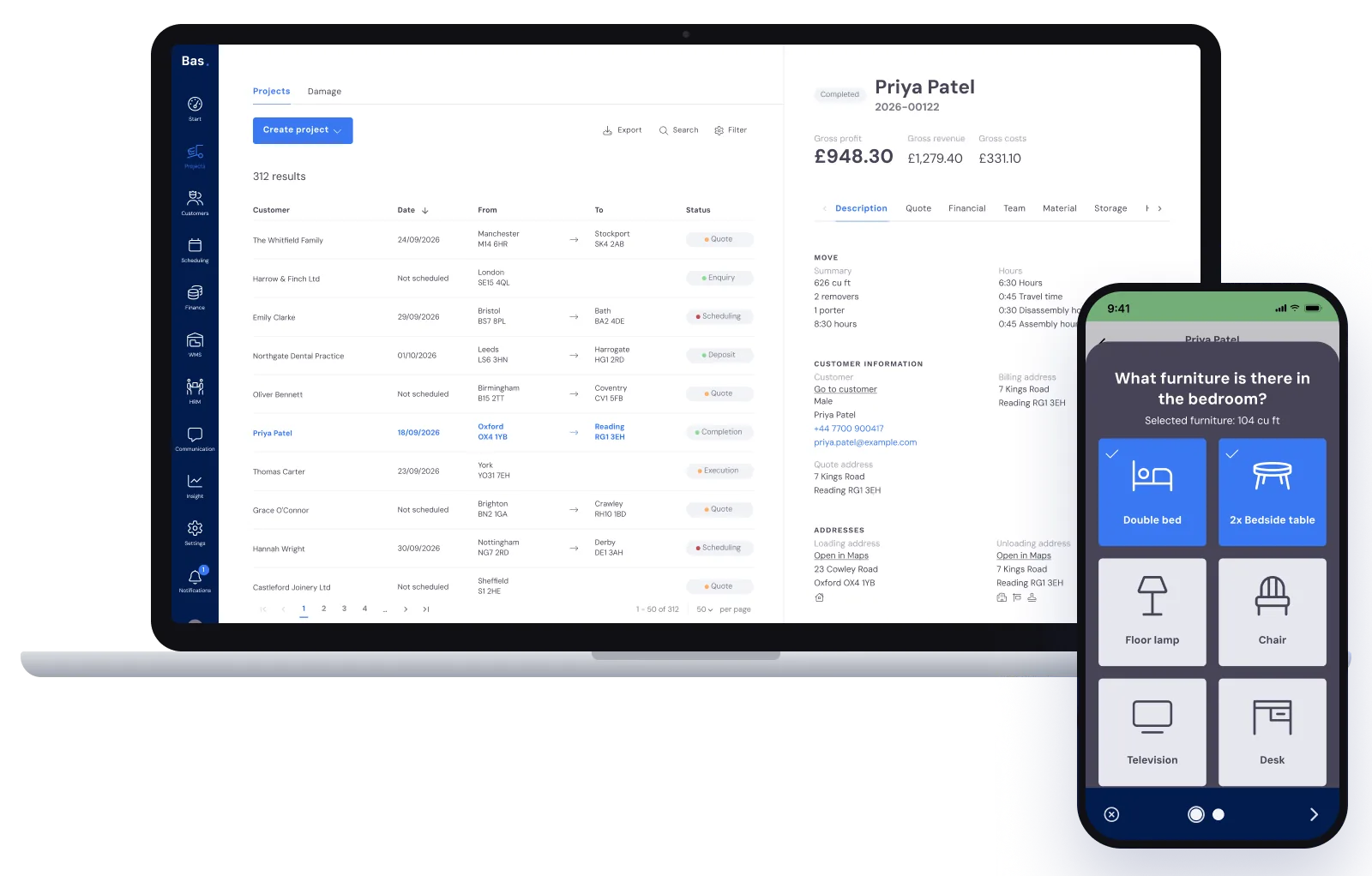
We write all our own code
Nothing is bolted together from bought-in modules. That sounds like a technical detail, but it’s the reason the chain below runs from end to end.
We mapped the trade first and wrote the software second
We started from how a removal company actually works, from enquiry to final costing. Not from a general business system with removals squeezed into it.
We don’t sell modules
It’s all in there. The only things we treat as add-ons are things that genuinely are separate services.
One job, from the first phone call to a paid invoice
This is what a job looks like in Bas.
Survey
Room by room on a phone or tablet. The inventory carries straight through to the quote.
Quote
The customer opens it online and accepts it there. No printing, no chasing a signature.
Diary
People, vans, trailers and travel time on the board. Conflicts and absences flag themselves.
On the day
The crew work from the app and clock their own hours. The foreman approves them.
Storage
Crates, containers and units scanned in and out by QR code.
Invoice
Straight off the job record, with the right rates and surcharges already on it.
And then you find out whether you earned anything
The hours, the materials and the mileage all sit on that job. So when it’s done, you can see what the job cost you against what you billed for it.
That’s where most systems stop. They plan the work and they invoice the work, but the cost never finds its way back to the job.
With those systems you learn how your month went when the accounts come in. With Bas you see it on the Friday afternoon it happened.
One system, one price
Three of the best-known removals software systems in the trade, and not one of them tells you what it costs before you ring them.
a modular approach with optional modules … international moves, trade storage, commercial moves and crate hire
Implementation Services, custom development
Request a demo
That’s a legitimate way to sell software, and all three are serious products. It’s just not how we do it. Bas is one system at one price, and the price is on our pricing page: from £200 a month, with training and support included.
Questions about Bas
The things removal companies want to know before they look any further.
Yes. The whole system runs in English, and so does the crew app. Bas also speaks Dutch, German and French, so a company working across borders can let everyone work on the same job in their preferred language.
A two-person operation and a firm with more than a hundred staff use the same Bas. There’s no cut-down edition and no enterprise edition. You pay for the people who use it, so a small firm pays less and still gets the full software.
Yes. The app runs on iOS and Android and the crew sign in on their own phones. They see their day, the addresses, what goes on the van, and they clock their hours as they go. No extra hardware to buy.
From £200 a month, and you can read the whole thing on our pricing page rather than waiting for a quote. The fee scales with the number of users, and training and support are included. Add-ons such as transport and the customer portal are priced separately. No setup costs.