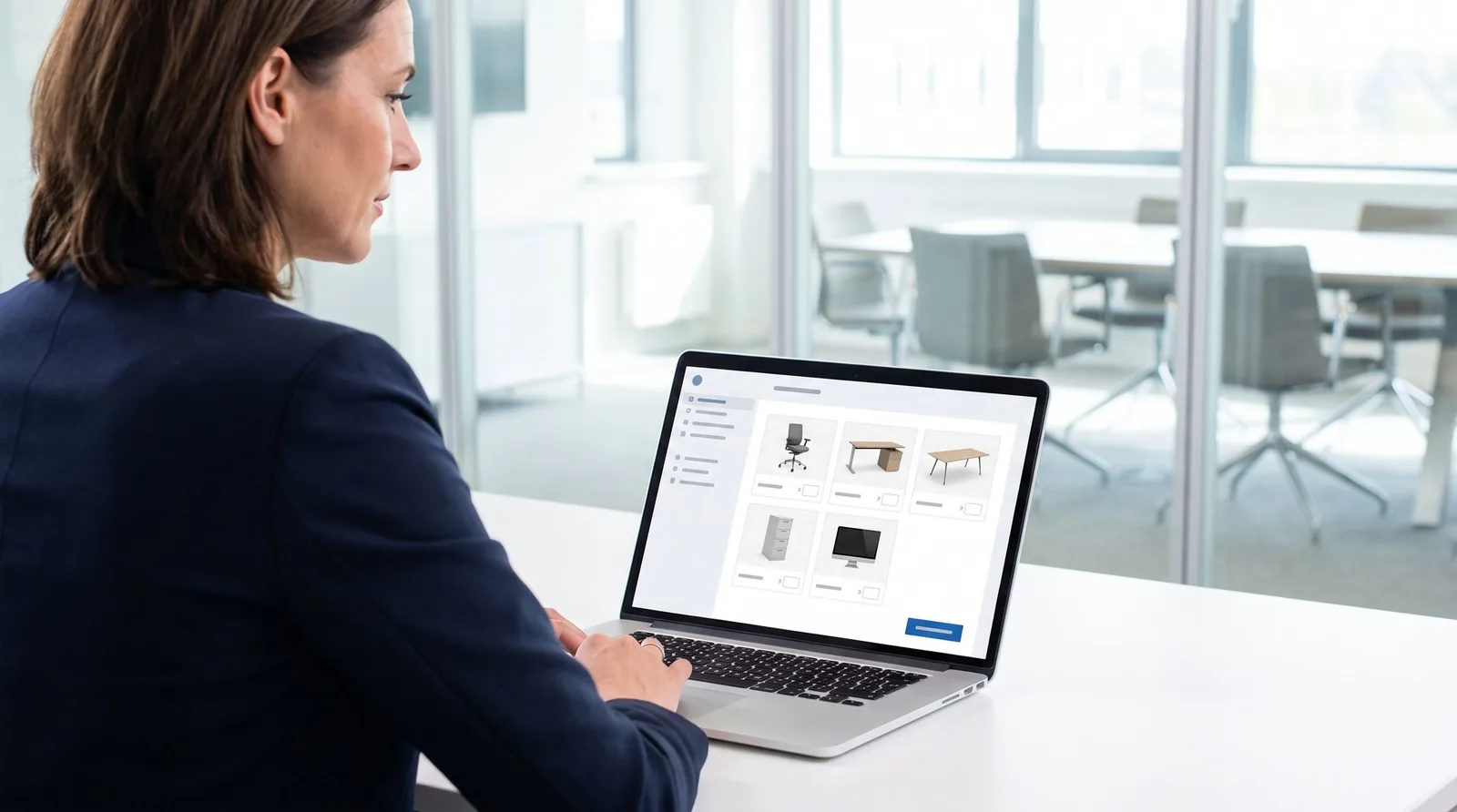
An office fit-out company asks you to collect twenty desks from their supplier and deliver them next week. A business customer has furniture in storage with you and wants four meeting tables back at the office. A school calls to ask whether you can bring back the digital whiteboards that have been in your warehouse for six months.
For many moving companies this has simply become part of the work, next to the moves. But it often runs on a spreadsheet, a WhatsApp group and the memory of the warehouse worker. With a few jobs a month, that works. There comes a point where it no longer does.
What is a TMS?
A TMS (transport management system) is software that runs transport from start to finish: what comes in, which stops are driven, who drives them, what was delivered and what you invoice for it. A WMS (warehouse management system) does the same for what is in your warehouse: which goods belong to which customer, and in which location.
At a moving company the two overlap. What you collect often goes into storage first and leaves again later.
A transport job is not a move
A move goes from A to B, with one customer, one crew and an inventory list. A transport job works differently:
- Several stops. Collect from the supplier, unload at your warehouse, deliver to two addresses a week later.
- Packages instead of an inventory. You work with parcels, pallets or single items you want to track one by one.
- A recipient who signs. Not the customer who placed the order, but reception or the facility manager on site.
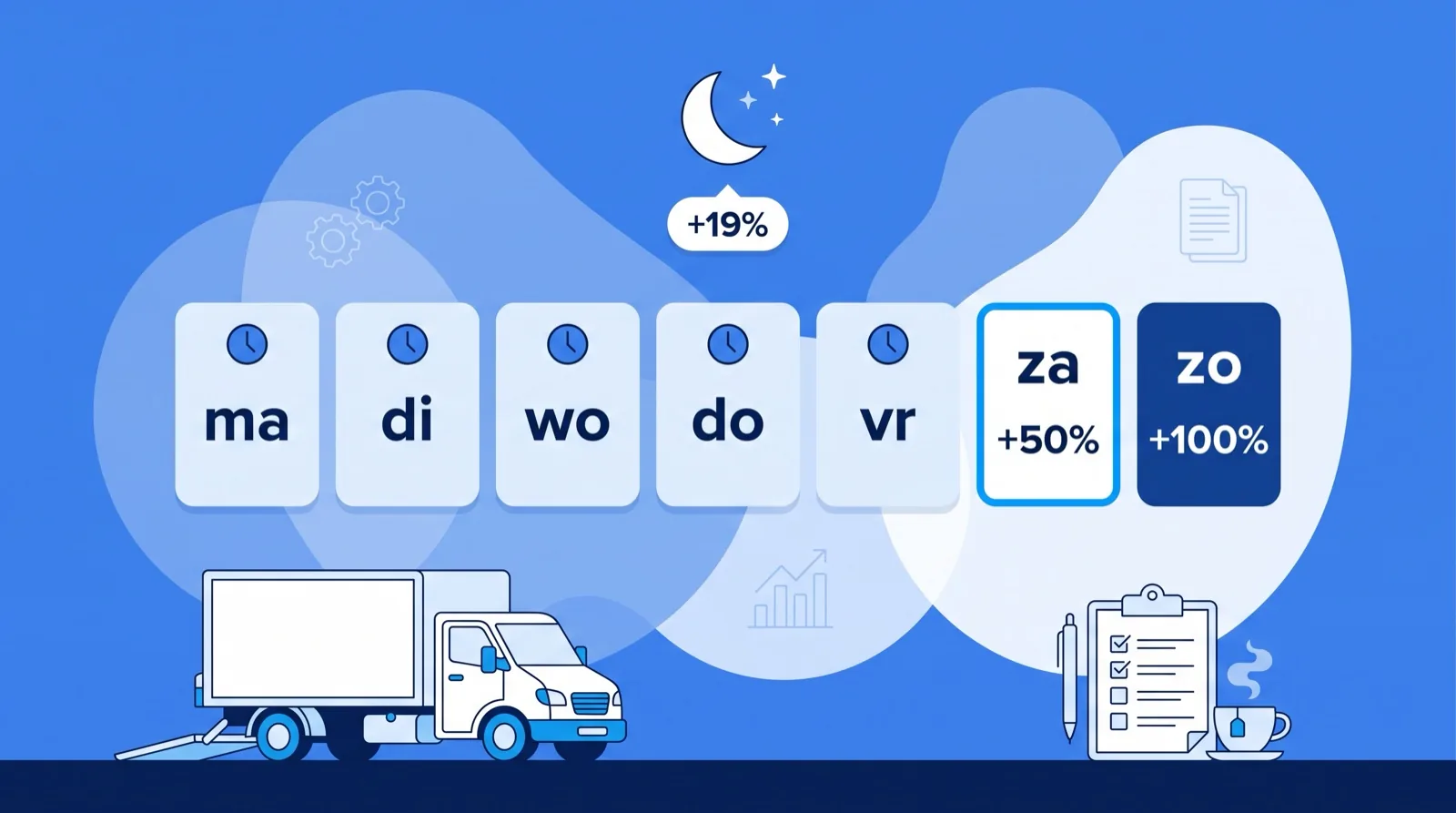
- Different rates. You charge per stop, per kilometre above a threshold or per day in storage instead of per hour.
That is different data from a move. Software built only for moves has nowhere to put it.
Six signs you need a TMS
Recognise three or more?
- A business customer calls to ask whether something is with them or with you
- Every month you send customers a spreadsheet of what is in storage
- Finding a proof of delivery means leafing through a folder or a phone
- You only find out a package was missing when the customer calls
- For the invoice you add up stops, kilometres and storage days by hand
- The driver calls the office to ask what he needs to take
That question, "is it with us or with you?", is one we hear a lot from moving companies with business storage customers. It is a small phone call, but it says a lot. The customer has no overview, and you do not have it at hand either.
Not everything needs a sticker
A common worry is that a TMS means putting a sticker on every item. It does not. It works better to choose per type of goods:
| Type of goods | Approach | Why |
|---|---|---|
| A hundred identical desks | Count quantities | The customer does not care which desk it is |
| A set-up workstation per person | Sticker per item | It has to go back to the same employee |
| Expensive equipment | Sticker per item | In case of damage you want to know which unit |
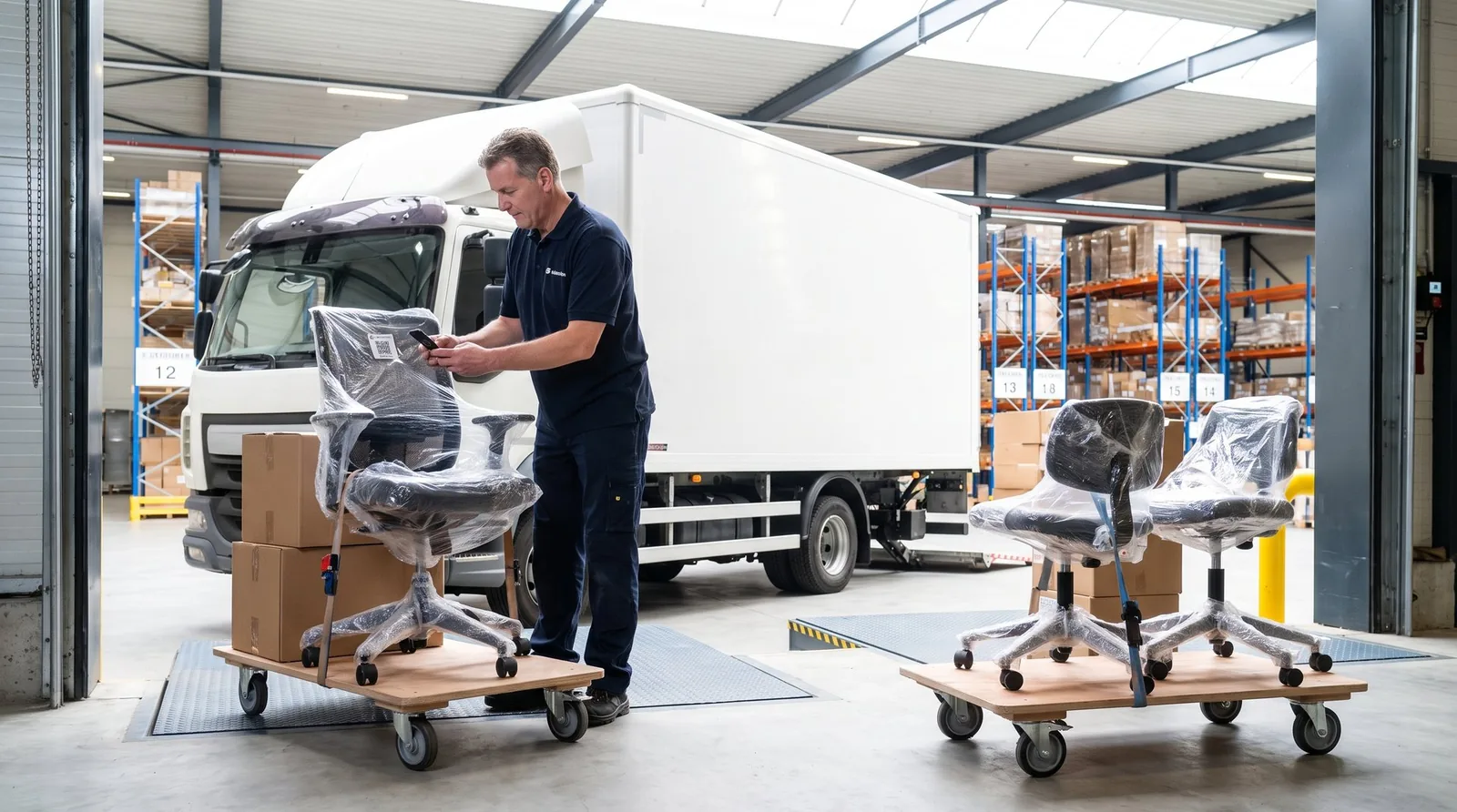
| Stackable chairs | One package per stack | One scan instead of five |
Stickers with a QR code work better than barcodes. A phone camera reads a QR code faster and more reliably, even when the code is slightly damaged or high up in a rack. Give your racks and bays a QR code as well, so when putting goods away you scan the item first and then the location.
Structured or unstructured delivery
There is another choice that matters more than the software: how goods arrive at your warehouse.
With unstructured delivery, a truck arrives with shipments for ten different end customers mixed together. Your warehouse worker sorts them, puts them on a pallet per customer and waits until a shipment is complete. That is a lot of manual work.
With structured delivery, you know in advance what is coming, for whom and where it has to go. You only need to receive it, put it away and deliver it.
More and more moving companies choose the second on purpose, and ask their clients to deliver in a structured way. A TMS makes that easier: the customer can enter the order themselves, and you see in advance which packages to expect.
What a TMS for a moving company should do
Not every TMS suits a moving company. These are the points that make the difference in practice:
- Receiving per package, with a QR sticker. So you see per customer what is still to come, what is in stock and what is ready to ship.
- Stops on the same planning board as your moves. You drive with the same crews and the same trucks. A separate board for transport means planning twice. See how that works in planning.
- An app for the driver. Scanning when loading and delivering, a signature from the recipient and photos as proof of delivery.
- Exceptions with photos. Damaged, missing, wrong item: recorded on the spot, and a missing package is scheduled as a follow-up delivery.
- Quantities for the invoice. Kilometres, stops and storage days come from the project, so your invoice no longer has to be done by hand.
- Roles. The driver unloads into a collection bay, the warehouse worker puts it in place. Each sees only what they need.
"A TMS does not make your transport more complicated. It takes out the phone calls, the spreadsheets and the searching."
A separate TMS or inside your moving software?
You can run a separate TMS next to your moving software. Then you have two plannings, two customer files and two places where hours and invoices come from. That is exactly the problem we described earlier in separate tools or all-in-one.
For a moving company it works better when transport is part of the same system: the same crews, the same trucks, the same customer and one invoice. That is how transport in Bas works: a transport job is a project next to your moves, with packages, stops and a proof of delivery.
When a TMS for movers is not the right fit
To be fair: not every transport company benefits from this. Do you run dozens of trucks with pallets across the country, with overnight cross-docking and cooperation between carriers? Then you need a TMS built for that, with route optimisation and live fleet tracking, for example.
A TMS for moving companies is meant for what movers do alongside moving: small-scale and specialist transport, storage for business customers and deliveries from that storage.
Conclusion
With a handful of transport jobs a month, a spreadsheet and a good warehouse worker will do. If you recognise three or more of the signs above, that manual work costs you more than you think. And your business customers notice it too.
Do you want customers to see for themselves what is in storage and request a delivery? That is the next step: a customer portal.
Shall we grab a coffee?
Let us talk about transport and storage in your business.
Online or on-site, you choose.
Conversations between Bas and moving companies that run commercial transport and storage (2025 and 2026), ISO/IEC 18004 (QR code, error correction).