You have just moved an office in Antwerp. The job went well, the invoice is ready and you email it as a PDF. A week later the question comes back: can you send it via Peppol? For Belgian businesses that is no longer a wish but an obligation since this year. And the same rule is on its way in the Netherlands.
What do you need to arrange as a moving company now, and what can wait? Here is the overview.
E-invoicing in short
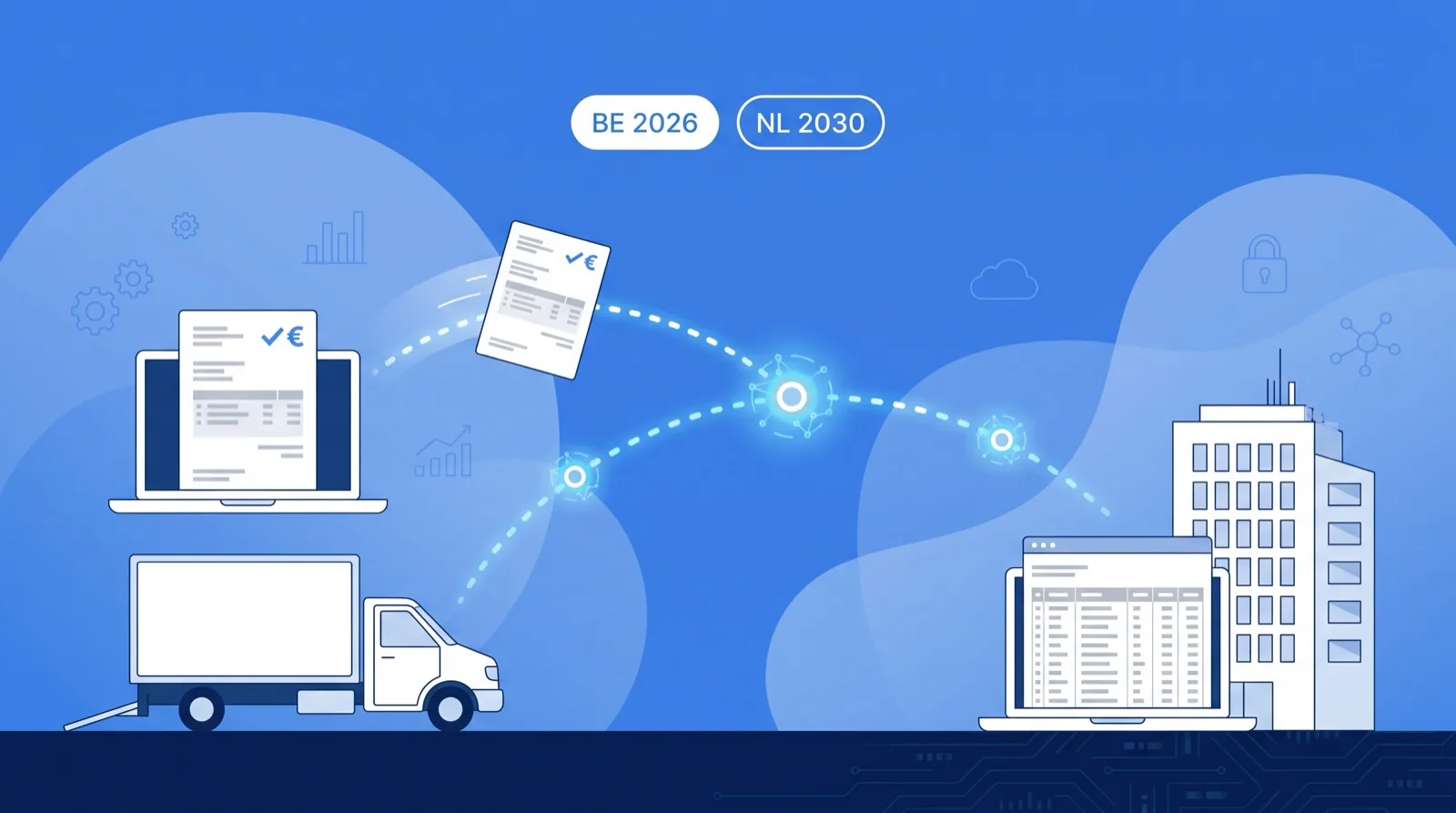
- Belgium Mandatory between businesses since 1 January 2026
- Netherlands Proposal: mandatory from 1 July 2030
- Private customers Excluded in both countries
- Fine in Belgium €1,500, €3,000, then €5,000
- Network Peppol, the European route for e-invoices
What is e-invoicing, and what is Peppol?
An e-invoice is an invoice in a fixed, structured format that an accounting package can read by itself. A PDF sent by email is therefore not an e-invoice, even though it is digital: someone still has to retype or scan it. The European standard for e-invoices is called EN 16931.
Peppol is the network that carries those e-invoices from one package to another. You send the invoice from your own software, and it lands directly in your client’s accounting. No mailbox, no retyping, no invoice that gets lost.
Is e-invoicing mandatory in Belgium?
Yes. Since 1 January 2026 Belgian VAT-registered businesses must send each other e-invoices, in principle via Peppol. They must also be able to receive e-invoices. The government gave businesses until the end of March 2026 to get used to it. That tolerance period is over.
A few groups are exempt, such as small businesses under the exemption scheme up to €25,000 turnover. Invoices to private customers are not covered. Businesses that do not comply risk a fine of €1,500 for the first offence, €3,000 for the second and €5,000 for each one after that.
Belgium is going one step further. From 2028 the government wants businesses to pass their invoice data to the tax authorities almost in real time. That is planned, but not yet law.
When will e-invoicing become mandatory in the Netherlands?
According to the government’s proposal, on 1 July 2030. That is set out in a letter to parliament of 11 September 2026. From that date businesses must send each other e-invoices, both within the Netherlands and to other EU countries. From 1 July 2031 a digital VAT report for domestic invoices follows.
A few things are still open. The bill is due to go to parliament before summer 2027. Small businesses under the Dutch small business scheme (KOR) do not have to take part domestically. And the Netherlands has not yet chosen Peppol as the mandatory network. The government is still looking into it, although Peppol is the obvious route. Many articles online present it as settled, but that is not correct.
If you work for the Dutch central government, you already have to invoice electronically. Peppol is the usual route there.
What does this mean for your moving company?
That depends on where you are based and who you work for.
| Your situation | What applies |
|---|---|
| Belgian moving company, business clients | Mandatory now: send and be able to receive e-invoices |
| Dutch moving company, business clients | Under the proposal mandatory from 1 July 2030 |
| Dutch moving company, central government clients | Already invoice electronically today |
| Move or storage for a private customer | No obligation, in Belgium or the Netherlands |
Are you a Dutch moving company with Belgian business clients but no branch in Belgium? Then you do not legally fall under the Belgian obligation. In practice Belgian clients do increasingly ask for an invoice via Peppol, because their own accounting runs on it. If you do office moves or offer storage for business clients, you will get that question well before 2030.
Sending and receiving: who does what?
E-invoicing has two sides. You send sales invoices to your clients, and you receive purchase invoices from your suppliers. Those are two different places in your administration.
You create sales invoices in your moving software, because that is where the job, the hours, the storage and the agreed prices are. From that software they go to the client via Peppol. You receive purchase invoices in your accounting package, because that is where they belong. Most accounting packages can receive Peppol invoices.
With a good integration the circle is complete. With Exact Online, for example, Bas fetches the purchase invoices back and you link the costs to the job. That way you see per move what it really earned.
How does Peppol work in Bas?
In Bas you switch Peppol on per client. You enter the Chamber of Commerce or VAT number for a Dutch client, or the enterprise number or VAT number for a Belgian client. From then on the invoices for that client go via Peppol automatically. On the invoice you can see whether it arrived, and if something goes wrong, you see what. Nothing changes for your other clients.
Want to use Peppol? We switch the integration on for you. How you create and send invoices is explained under invoicing, and which accounting packages connect to Bas under integrations.
What you can arrange today
- Find out which business clients already ask, or will ask, for Peppol
- Collect the Chamber of Commerce, VAT or enterprise number of each business client
- Check whether your accounting package can receive Peppol invoices
- Make sure your sales invoices come from one system, not from Word or Excel
- Based in Belgium: check that you already send and receive via Peppol
The Dutch law is still being drafted. The government wants to open a public consultation in autumn 2026, and the bill follows before summer 2027. As soon as anything changes, we will update this article.
Just starting a moving company? The paperwork for a new moving company covers what else you need to arrange in the Netherlands and Belgium.
Shall we grab a coffee?
Let’s talk about e-invoicing and how to get invoicing right in your company.
Online or on location, you choose.
Belgian Federal Public Service Finance, efactuur.belgium.be: who must e-invoice, B2B FAQ, fines, end of the tolerance period (7 April 2026) and e-reporting. Dutch government, letter to parliament on electronic invoicing and reporting (11 September 2026). Ondernemersplein, sending an e-invoice to the government. European Commission, VAT in the Digital Age (ViDA). Bas help centre, Peppol and the Exact Online integration.